

Canada has surpassed four million hectares burned by wildfires for the fourth consecutive year, federal officials said Tuesday, forecasting that September will continue to see “above average” wildland fire danger across the country.
More than 4.1 million hectares have burned across the country so far this year driven by dry conditions in British Columbia and the Northwest Territories and large fires in Saskatchewan, Ontario and Quebec. While officials say the 2026 season has been less severe than last year by some measures, the trend points to a growing wildfire threat.
When Emergency Management Minister Eleanor Olszewski first provided a wildfire national update in July, roughly 410,000 hectares had burned across Canada. That figure has since ballooned, with roughly 20,000 evacuees and thousands displaced.
“I also want to take a moment to thank the first responders for their really tireless work in protecting families… that includes more than 500 international firefighters,” Olszewski said.
Firefighters from Mexico, Australia, New Zealand and Costa Rica are assisting with the response, with more deployed in British Columbia.
As the wildfire threat grows, Ottawa is also weighing whether to expand Canada’s aerial firefighting capacity ahead of next year’s season.
Olszewski said the government is currently working with provinces and territories to assess their firefighting fleets and expects to make a decision on additional leased aircraft by the end of the year.
“We’ll be making a decision with respect to leased aircraft,” she said. “We will want those to be in place for the next wildfire season.”
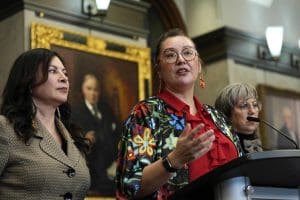
Indigenous Minister Mandy Gull-Masty also spoke on the disproportionate effect wildfire had on First Nations communities, particularly in northwestern Ontario.
Since July, Canada saw 40 fires impacted across 38 First Nations, with 4,294 evacuees and 1,425 Indigenous people displaced.
Ottawa has also put $55 million toward helping First Nations prepare for and respond to emergencies, including wildfire mitigation and community-level capacity.
Another $718,000 in FireSmart went to First Nations and tribal communities in Atlantic Canada for measures such as vegetation management in high-risk areas, while 321 First Nations emergency management coordinator positions are federally funded across the country.
“My priority is to ensure that First Nations have access to the support they need before, during and after an emergency. To strengthen how we are working together,” Gull Masty said.
Some First Nations in northern Ontario have criticized the provincial and federal response to this year’s evacuations, with calls for national inquiry into how the wildfire emergency was handled.
Asked whether Ottawa would support an inquiry, Gull-Masty did not commit to one, instead pointing to the need to learn from this year’s response and clarify the roles of First Nations, provincial and federal governments during future emergencies.
“We note the intensity. We note that they are continuing to be longer and quite challenging to understand at what point these things will be triggered, but we also want to ensure that in moving forward we are taking those lessons learned at this time,” Gull-Masty said.
Similarly, when asked whether the government plans to address climate change to prevent worsening wildfires, both ministers said they acknowledge climate change as a major contributor to the disasters.
Olszewski noted that she is aware that people are concerned with major projects along with the MOUs signed with Alberta, but noted that the agreements puts climate change “front and center,” pointing to setting effective industrial carbon price.
Despite the handful of initiatives and strategies Ottawa has set out to protect nature, a climate activist said focusing on emergency preparedness, while important, is not enough.
“We should not be talking about emergency preparedness without also talking about what is causing the climate emergency in the first place, and this is the decision to continue investing in and expanding fossil fuels despite the fact that it is destroying communities, livelihoods and our environment,” Laura Kenyon, Greenpeace Co-head of Climate Program said in an interview with iPolitics.
Kenyon argued the growing cost of fighting wildfires shows the price governments are already paying for worsening climate impacts. She pointed to British Columbia, which spend $510 million managing wildfires in 2025, contrasting that with the Carney government’s $34 million climate resilience fund, a program designed to help 141 municipalities adapt to climate change.
“You really cannot divorce that from this energy superpower push and this investment in fossil fuel expansion… it will completely dwarf any kind of emergency preparedness investment we can make if we pursue this fossil fuel energy superpower agenda,” Kenyon said.
In an earlier press conference in Vancouver today, New Democrat Parliamentary Leader Don Davies filed a formal complaint with the Competition Bureau alleging the Carney government for violating Canada’s anti-greenwashing laws.
“As Canadians watch their communities burn, the Carney government is spending millions of tax dollars to mislead them,” Davies said.
“The Prime Minister has admitted that emissions will rise under its energy plan, yet his government is running ads claiming it will lower them.”


